

What Hidden Spaces Teach Us About Leadership, Creativity, and the Courage to Look Deeper
“The most beautiful things are often hidden in plain sight, waiting for our curiosity to uncover them.”
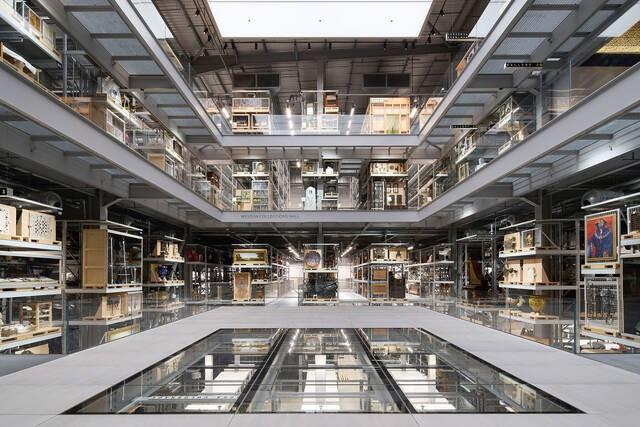
On a recent trip to London, I took a journey that wasn’t on the usual tourist map. I ventured out to the Victoria & Albert East Storehouse, located near the Queen Elizabeth Olympic Park — a new, modern facility that offers something rare: a glimpse behind the curtain. Having visited London many times before, I have seen the city’s celebrated cultural landmarks — the soaring galleries of the Tate, the timeless beauty of the British Museum, and the grandeur of the main Victoria & Albert Museum in South Kensington. But this was different. The East Storehouse isn’t a place of polished displays. It’s a living archive, a working collection. It’s where the unseen art of curation happens.
It took effort to get there — a series of train rides and a walk through unfamiliar streets — but when I finally arrived, the experience was worth every step. As I wandered through vast storage halls lined with thousands of artifacts, I realized I wasn’t just looking at the hidden treasures of a museum. I was standing in a metaphor for how we live, lead, and create.
The Power of the Unseen
Walking among the objects, sculptures wrapped in protective coverings, paintings waiting for restoration, furniture stacked in quiet formation, I was struck by the magnitude of what lies beneath the surface of what the world typically sees. The V&A, like most institutions, showcases a curated fraction of its collection. The rest, however, is no less meaningful. These stored pieces represent the process, experimentation, and raw material behind cultural evolution.
In our own lives and organizations, we do something similar. We display the outcomes — the polished presentations, the perfected products, the confident decisions — but rarely do we reveal the vast ecosystem of exploration that sits behind them. And yet, that’s where growth truly happens.
What if, as leaders and creators, we learned to value the unseen parts of our work as much as the visible ones? What if we created time to explore the shelves of our own creative “storehouse” — the unfinished projects, the half-formed ideas, the quiet talents within our teams that rarely get showcased?
Rediscovering Hidden Genius
The visit reminded me that behind every great idea lies a messier process filled with drafts, doubts, and detours. It’s easy to forget that brilliance doesn’t emerge fully formed; it’s discovered in layers.
Consider the story of J.K. Rowling, who carried around early scraps of Harry Potter on napkins and old notebooks. Or Steve Jobs, who was obsessed not only with what Apple displayed but also with the elegance of the internal components no user would ever see. For Jobs, the unseen design mattered as much as the exterior; it was a reflection of care, integrity, and artistry.
In both cases, the power came not from what was immediately visible but from the depth of what was hidden — the unseen rigor, the persistent curiosity, the willingness to dwell in ambiguity before clarity emerged. That’s the gift of spaces like the V&A East Storehouse: they remind us that the unseen isn’t meant to be hidden out of shame or irrelevance; it’s preserved for discovery.
The Courage to Be Curious
Curiosity, I have often found, is an act of leadership. It’s easy to stay within the comfortable and the known, but growth requires the courage to explore beyond the obvious.
When organizations cultivate curiosity, they create the conditions for serendipity — those moments when unexpected insights surface from unexpected places. Take IDEO, for instance, the global design firm famous for its human-centered approach. Their innovation process is built on what founder David Kelley calls “constructive chaos.” They deliberately spend time exploring the edges, talking to outliers, testing wild ideas, and revisiting past failures because that’s where the next breakthrough often hides. This example echoes the spirit of the East Storehouse: innovation emerges when we invite people to wander the archives, to explore beyond the curated version of success.
Leading from the Backroom
In leadership, a subtle yet powerful shift is happening. The best leaders are no longer just curators of outcomes; they are curators of discovery. They create environments where people can bring forward what’s hidden. This doesn’t happen through performance reviews or annual innovation challenges; it happens through everyday curiosity. A leader who takes the time to ask, “What’s something you’ve been thinking about that we haven’t talked about yet?” or “What’s a project you’d love to revive if time and resources weren’t a constraint?” opens the door to creative revelation.
At one pharmaceutical company I worked with, a mid-level scientist proposed an idea for a new delivery system that had been dismissed years earlier. When leadership revisited it, simply because they made space to explore dormant ideas, it led to a breakthrough that saved millions in R&D costs. Sometimes, leadership isn’t about charging forward; it’s about turning around to see what’s been left behind.
The Inner Storehouse
There’s also a personal dimension to this metaphor. Each of us carries an internal storehouse of memories, experiences, and insights — some well cataloged, others gathering dust in the corners of our minds. When we take time to revisit these inner collections, we often find connections we’d forgotten were there.
Think of how a forgotten hobby, a childhood curiosity, or a long-shelved idea can suddenly feel relevant again. The artist who once studied biology brings a new perspective to climate design. The engineer who loves poetry finds a new language for empathy in leadership. These intersections — the unseen meeting the seen — are where multidimensional thinking comes alive. Curiosity here becomes not just an external act but an internal pilgrimage. It invites us to slow down, reflect, and ask: What in me deserves to be rediscovered?
Beyond the Exhibition
When I left the East Storehouse that day, I found myself thinking less about the art I saw and more about the art I hadn’t. The unopened crates, the covered sculptures, and the sketches still waiting for context all represented something essential: potential.
We live in an era obsessed with visibility — metrics, social proof, personal brands — but meaning often lives in what’s unmeasured. Leaders who want to build resilient, creative cultures need to learn how to make space for the invisible work because that’s where trust and innovation grow.
So, the next time you feel pulled only toward the “main exhibition” of your life or organization, pause and look behind the curtain. Wander through your own storehouse. You might find that the treasures you’ve been seeking aren’t waiting to be discovered somewhere new; they have been waiting for you to notice them all along.

0 comments
Leave a comment
Please log in or register to post a comment