

Breaking The Traditional Leadership Monopoly: A New Vision With Maria Brinck
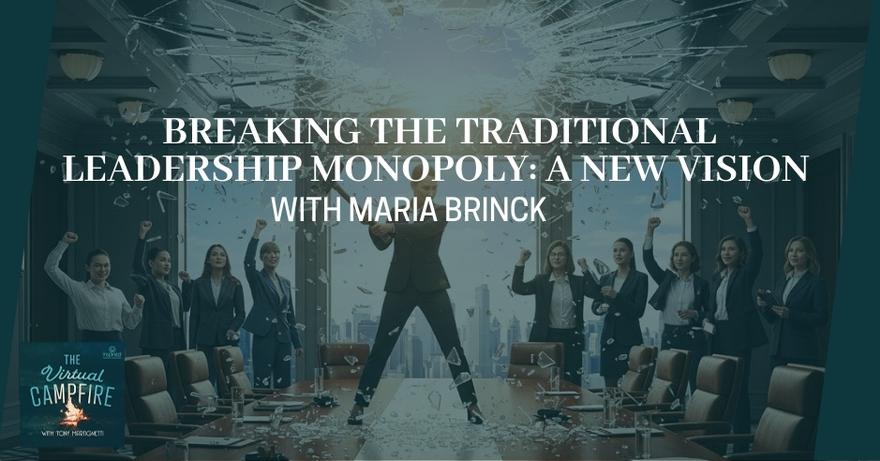
A new vision for leadership is critical for solving today's global crises. Visionary thought leader and Zynergy International founder Maria Brinck shares her transformative journey, discussing the essential need to break up the traditional leadership monopoly. As the head of a leadership advisory firm founded in 2013, Maria works with board members, CEOs, and executives to generate the diversity of thought necessary for today's global problems. Her personal shift from an executive sales career to working with chimpanzees and indigenous people in the Cameroon rainforest forged a unique perspective on the true balance of masculine and feminine qualities. This balance, she argues, is missing in corporate America where 80% of employees are disengaged. Maria also delves into the core ideas of her book, The Leadership We Need, explaining that stepping outside of our comfort zone is the key to personal "aliveness." Ultimately, a global-minded approach, embracing the wisdom of all humanity, is vital for solving our biggest challenges and building a bright future.
---
Listen to the podcast here
Breaking The Traditional Leadership Monopoly: A New Vision With Maria Brinck
It is truly my pleasure and honor to welcome my next guest, Maria Brinck. She's a visionary thought leader devoted to breaking up the traditional leadership monopoly in order to generate the diversity of thought necessary to solve our most pressing challenges in organizations and nations. Maria founded Zynergy International, a leadership advisory firm that was founded in 2013 to fulfill her passion. Maria works with board members, CEOs, executives, business teams and HR professionals and is based in Colorado.
She was born and raised in Sweden and in Algeria, and Maria was educated in Sweden, France and the US with a focus on international business. Her most transformative experience was reshaping her worldview. It came when she lived and worked with indigenous people in the Congo Basin rainforest in a remote part of Cameroon. While working on the rehabilitation of chimpanzees and gorillas, she observed firsthand human planetary destruction and its consequences for all living things, but also the type of leadership we need to bring out our best in humanity. It is truly an honor to welcome you to the show, Maria.
Thank you, Tony, for having me. I'm very excited to be here.
Finding Your Spark: The Natural World And Leadership
Yes, we're going to have a great conversation and I just love the impact that you've had on your journey and just the experiences that you're going to bring to this conversation are going to be wonderful. Let's get this fire started. As we do in this show, we always explore people's journeys through what I call flashpoints, the points in our journey that have ignited our gifts in the world.
What I'm going to do is I'm going to turn over to you in a few moments just to share what you're called to share, and along the way, we'll see what themes are showing up and we'll see where we want to take things from there. Let's start with your first flashpoint. What are the things that really started the spark of your journey?
I think one of the things that a lot of people can relate to is where you grew up. You were surrounded by a certain culture, certain values, family values as well. I had the great fortune to be born and raised in Sweden. That has shaped where I'm at now profoundly. In particular, where I spent my summers in Sweden, which was on a nature reserve.
We’re very lucky that both my parents were able to take extensive time off to spend with me and my brothers. I think that connection not only to my own family but, maybe even more importantly, to nature has shaped where I'm at now. It's made me more grounded and also very passionate about the environment.
I love that you're bringing the natural world into this because there's something about that which we often forget, that nature is the best teacher. We have to get ourselves outside of our offices and outside in the world and also learn from our most ancient teachers, the animals.
Yes, there you go. They truly have it figured out, they really do on so many levels.
Growing up in Sweden, there is an element of being in the wild cold and winter, but also having a really wonderful summertime that reveals the blossoming of spring and summer. There is that diversity that really helps you to see the world in many different ways. I'd just love to hear a little more about your journey into the nature and what it taught you.
It is interesting because I didn't know even how profound that connection was. In Sweden, we also have celebrations around the seasons, the seasons of light and the season of darkness. Of course, midsummer is probably one of the most popular and well-known traditions, which is, of course, around solstice in the summer. We also have Lucia, which is in the solstice as well, on the 13th of December, going into the darkest time of the year to bring light to the people of Sweden at a time when we need it the most.
There is also a celebration around the natural and the seasons. I think what's interesting is, and really my next flashpoint was or really going to make sense, I guess, through a few flashpoints is, I lost a little bit that connection to nature and maybe also to my original culture coming over to the United States as an international student to follow the American dream, if you will.
I find myself disconnected to nature and disconnected to the seasons and everything and learning from animals, to your point. Of course, that's what later came into a flashpoint and I'm getting a flashpoint number 5 or 6 here but when I returned to nature many years later after being an international student, studying International Business, getting a job in corporate America, working in executive sales for eight years in big companies.
Biotechnology, pharmaceuticals, enterprise solutions, etc., realizing I'd lost some of that connection and feeling lost and hitting the wall of meaninglessness. Returning to nature in Cameroon, Africa, working with chimpanzees and gorillas and also observed some of the indigenous traditions as well. Yeah, it came full circle at one point.
The Wall Of Meaninglessness: Why Maria Left Corporate America
I want you to walk us through a little bit because there's a lot that you just shared, which is great, and it's an amazing journey. Tell me what prompted some of those changes. You came to the United States with the idea that you're going to get a degree in International Business, which is wonderful, and then you had this amazing corporate career. Tell me what prompted you to leave that career, because usually, people feel so comfortable in that world, collecting a paycheck and what have you.
It is very comfortable, yeah. Everything in the United States is very comfortable, and maybe that's one of the problems. You get very complacent. I think it takes away a little bit of your edge and feeling alive, because you do feel very comfortable and there's something lost in that comfortability, in that comfort. However, it's interesting because, like many international students, even those from Europe and Scandinavia, we still see the United States as on the forefront of, of course, business, commerce, trade, really anything business. Studying international business, the United States became one of the most attractive countries to study it in.
Ironically, I was actually living in Paris at the time, studying at the Sorbonne, and I realized that maybe French was not the most international language in the world currently, and that it would probably be better to study international in a country like United States and in English. Those were some of the reasons why I wanted to come here. I’ve always been very driven by just challenges, in general.
I thought it would be a great challenge to come to United States and it's a country where you can really make things happen. Maybe a little bit easier than some other countries that have a little bit more of bureaucracy and traditional way of doing things. I thought there is just a little bit more flexibility in the United States, like starting your own business for example and “making it.” What I didn't realize is that it also comes with a price, like with everything.
That price is interesting. You touched a little bit on that. It's everything is so convenient, it's comfort. I can give so many examples of that comfort. When you're hungry, you can eat right away because there's always food around, there's always a machine and you put in a few quarters and you get something to snack on, but it does take away a little bit of feeling alive of, “I'm really hungry.”
I got to feel that in Cameroon, where we didn't have a lot of funding and not a lot of food. The food literally had to go to the saving the chimpanzees and the gorillas. I lost a lot of weight. I'm not saying it's a good thing. Of course, I'm not talking about struggling families here and putting food on the table. I'm talking now about the people like myself who started businesses and fare inancially doing okay.
When was the last time you actually went hungry and sat down and like, “This is going to be so such an amazing meal? I am so thankful,” or even go to bed and you're actually full and it's so much easier to sleep? I never even felt that I couldn't sleep because of hunger until I got to experience Cameroon, where I went to bed often hungry and had a hard time sleeping because of it.
I knew I can always get out of there should I need to, and of course there's most people can't. I was one of the fortunate. Just to even have that experience, even if it was just a little scratch on the surface, it reminds you how good we have it and not to take it for granted. Maybe not to take it for granted, that is the icing of the cake.

I think this is why we need to have more experiences that allow us to get out of our comfort zone and have a sense of humility because of the fact that it gives us more of a feeling of what other people are experiencing in the world. When we do that, it comes back to how we're going to serve differently. If we just grow up in a world where everything is just given to us, everything is comfortable, what we start to do is we start to feel this sense of complacency. We feel like everything is easy or just becomes this sense of everything's laid out in front of us. When we start to realize not everything is easy and I need to sometimes see things through a different perspective that perspective is like gold for people who want to navigate in a world differently.
There's so much focus right now too on gratitude. I think even being appreciative of the simple things in life. We take that for granted in the United States and also in Europe. The gratitude, what a difference that can make in your everyday life. Even if you take a few minutes here and there throughout the day to just be thankful for the things we have. I love what you're saying about getting outside of your comfort zone.
As you know, in executive coaching and leadership trainings, that's what it's all about, growing as a human being, stepping out of that comfort. The irony there is yes, it's uncomfortable, but man, do you feel alive. That's when you come alive. I think that's a sign that we should do it more often. People say, "I just feel so stuck, it's boring. There's no excitement." what you're lacking is feeling alive. There are ways we can bring that into our lives. I think one of the greatest ways to do it is just really stepping outside of your comfort zone.
One of the things that the word you used is really powerful and I think it's something that as we enter 2026, it's a word that I'm going to connect to and it might be my word of the year, aliveness. I think we all want to feel a little more aliveness in our world, so let's see how that transpires.
Something else you might want to add into your 2026 is, besides slowing down and maybe 3, 4 times a day, think about gratitude and what you appreciate with that day, whether it's a meal or a call or a connection with a friend or whatever it might be. Another thing you might want to add is a 1 or 2-sentence gratitude right before you go to bed.
Gratitude, what a difference that can make, in our everyday life.
I started doing that and it's amazing. A lot of people like to do it in the morning, but my mornings are just too hectic with two kids getting to school etc. If you do it in the evening right before bedtime, it's also amazing because it's when you gather these little tracking all those days that are of gratitude, all of a sudden, you feel a tremendous appreciation for your life overall.
Here's another day and another day and it grows on its own. I notice when I try to do it in the morning, there's a little bit more anxiety around it because you're starting the day and now the expectations are starting. Pressure on. You better not have a bad moment. Of course you're going to have bad moments, and then you're going to think of different reason. I prefer to move it to the end of the day, right before bedtime, and it's also an easy routine. You can do it right after brushing your teeth. You already have a routine and then you put it in there, it makes it easier to actually create a routine around it.
I love this particular tip. This is great, because it's like the spaciousness of you're about to wind down so there's spaciousness there. As opposed to in the morning when you're like feeling like, “The day's starting. I’ve got a lot happening.” Your mind starts racing towards all the things. Even if you're the most grounded person and you're saying like, "I'm going to start today with a meditation," that's all great, but there's still a sense of energy with the day starting and it's hard to have gratitude.
You're supposed to set an intention for the day and within ten minutes, that intention went away and you're like, "There goes that." You feel like a total failure for the rest of the day. Not good. Move it to the evening if you're struggling with that morning intention and meditation etc. I highly recommend it.
From Cameroon To Corporate: Starting Zynergy International
I want to move into the next flashpoint. After spending your time in Cameroon, which is remarkable and obviously a huge flashpoint to be spending that time there, what brought you back from there and what happened next in your journey?
I felt that the connection and feeling alive that I felt there was something that I wanted to take back to my everyday life. I was considering where that next everyday life would be, whether it would be going back to Sweden or Europe. Obviously, I mentioned I lived in France before coming to United States or if it was going to be United States. There are many reasons why I wanted to come back to United States because I still felt that there was a part of me that wanted to start my own business, loving the traditional challenges of the society, which is competitiveness.
I definitely have that masculinity in me like we all do. Also, obviously, this is in my opinion, it’s a society that overly values the masculine and you can get stuck in it, if you will. What I mean by the masculine is being daring, being aggressive, being self-confident, short-term focus, and competition. I did very well in that environment and there's part of me that really likes that.
Of course, as I mentioned, hitting the wall of meaningless, I realized I’ve let go of a lot of things in the feminine that really keeps us in balance and check and balances are always a good thing. I realized it was really the connection with nature, animals, and also, think about the connections I have back with my family and friends, etc., and spend more time on that as well.
I realized there is a way to do both. I wanted to take my experience of Cameroon and never, ever let go of spending time in nature. We can all do it. I'm sure most of us live close by enough where we can bring it into our everyday life to just go out and slow down and connect. A lot of us have pets and dogs and cats and other pets that can really bring tremendous joy.
We have to slow down and pay attention and really be in that awareness when we are with our loved ones, being pets and also people, of course. I thought maybe the best way to do it would be to start a leadership advisory firm where I could break into leadership teams and offer them something that maybe nobody else have offered. I know a lot of executive coaches and advisors went to the same schools as a lot of the executives that they're then coaching.
We had to slow down, pay attention, and truly be present when we are with our loved ones.
They come from very similar backgrounds, maybe even met at summer camps etc. Also very similar demographic. I thought with the world perspectives I have from growing up in Sweden and Scandinavia to Algeria to Cameroon and lived in France and other places, I thought that, together with my time spent with the indigenous and working with chimpanzees and gorillas, can offer something very different.
I thought it would be interesting to try to see if I could be of value to break up executives that feel stuck in their work or just bring a new mindset into business since I also had education in business and spent myself eight years in executive sales. I knew a little bit about that pressure of always try to perform or always need to perform or you will be without a job. Also, the feeling that you're just a number and all they care about is the quota.
Are you hitting the quota or not? If not, you're out. I know very much how that feels. I could relate on that notion. That's how I thought and, of course, to have the impact in the world that I'm hoping that that widening of perspective would give the executive a really start to care about the company's impact on environment, on animals, on ecosystems, and on communities, on people, employees, of course.
As you know, Tony, just go back to focus on employees, we have a huge number of employees being disengaged at work, about 80%. We know that current leadership is not quite cutting it to make work exciting enough and motivating enough and meaningful enough for people to show up at their best. Also, I really wanted to help out trying to figure out how we can turn those numbers around and move the needle.

Why Your Unique Story Is Your Best Leadership Tool
What I'm feeling as you share all this is because it's so interesting a lot of people feel like, "Everyone's doing executive development and training in this way. Therefore, that must be working or it must be the path that I need to follow." as I’ve uncovered through all of these conversations, your story and your experiences are what make you stand out as why this particular path is important for other people to see.
You start to accumulate all of these things along the way and because of that, you start to say, "I have to do it my way, in my own unique way.” By doing so, I'm giving other people permission to get out of their own let's call it box or their own way of showing up so that they can start to see that the path to better leadership is to strike that balance between who I am and what is required of me in this particular world, the environment that I'm in. Through that process, they become more wholly themselves.
I just wanted to stress a point here too, that when I bring in a little bit of my perspective and experience, I am obviously not promoting anybody moving to Cameroon or anything similar to that by the way. The irony is we have all those things that will challenge you and put you outside of your comfort zone all around you every day.
There are things you can do, there are people you can talk to, there are soup kitchens you can work in, there are animal shelters. There could be such a small thing as connecting with your children that might not have done in the past, or picking up the phone or grandkids or whatever it might be. We're talking about connections here and just getting into the feminine in all of us and what's really important.
You become an influential leader by meeting people where they're at.
It's really about relationships. How those relationships is going to be for that unique individual is all based on their unique individual. I want to just stress that. This has nothing to do with living my life because everybody's unique. The key is to get into the feminine and get the masculine in check because I think that's what's missing very much in America as a whole, but even more so in Corporate America and its culture nowadays. That's what I'm hoping to bring and how that looks like is obviously for that executive to figure out, what brings them meaning in life and what brings them belonging and happiness and well-being. I'm not one to prescribe to them what that is.
It's about finding that and we always talk about this word balance, but it's about striking the right place on the continuum. How much of the feminine do I need to bring back in and masculine to keep in? Oftentimes, we do need that. We can't just like completely strike it away. We do need to have that continuum of what needs to be brought into my leadership, into my expression, so that I can feel like I'm showing up more fully myself, but because there's an element that I might be leaving behind that I need to bring into the table.
I think the beautiful thing when you do that is, like you said, is a continuum, is that you can turn it up or turn it down as needed to the situation and to the person that you're speaking with or engaging with. Some people prefer more of a feminine and some people prefer more of a masculine, and both are totally fine.
The key is to have found both in you so you can have more of a wide range of tools available to you to meet that person because how you become an influential leader is by meeting people where they're at. To be able to become more of an influential leader, you need both because some people are going to want to approach more with a feminine, whereas other would prefer to be approach more with the masculine, and some people want a perfect balance. It's very important and I just think it brings so much more depth to you as a human being and it also brings so much more joy and fun and aliveness when you have that wider range and feel more holistic in yourself.
The Vision Behind The Leadership We Need
I want to explore the next flashpoint which I'm going to lead the witness, if you know what I mean. I'm expecting it's going to be around your book, which we haven't even mentioned yet. Let's talk about the book and what brought you to writing this book. First of all, let's just put it out there. Mention your book and what it's about.
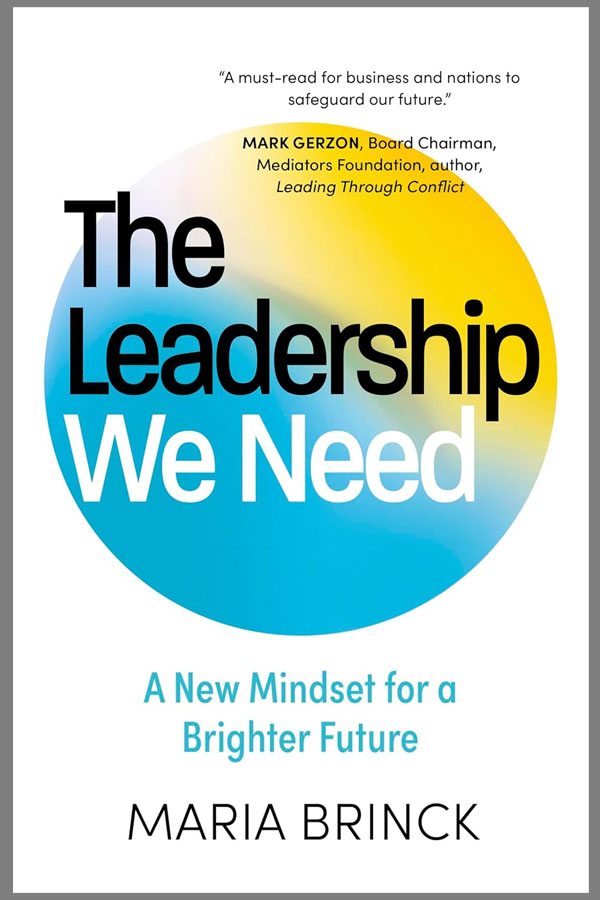
The book is called The Leadership We Need. It really speaks to this very different leader. It's like the executive that we talked a little bit about here, who is more of a holistic approach. The reality, Tony, is that we have been led for over 10,000 years, since the dawn of civilization, by a very masculine type of leader. Not only have men monopolized leadership, but a very stereotyped or hyper-masculine type of men.
 Maybe or maybe not that was needed, I can't speak to that because I'm not an expert on that in per se. What I do see very clearly in 's world, considering we are living in a polycrisis reality, is that the leader is just not cutting it. Back in the days when maybe we were fighting barbarians at the gate, if you will, we needed that aggressive, overly confident leader who was that person to keep the tribe safe from other tribes. Considering where we're at now, I couldn't think of anything more dangerous.
I would actually argue that we need the exact opposite, or at least we need a true balance of the masculine and the feminine. Maybe not a true opposite. That's probably a little bit extreme so I might want to take that back. Definitely, it feels like I want that because the masculine is so masculine, but what we need is a balance. How do we get to that balance?
That's something I write about in The Leadership We Need. It's a full representation of humanity leading humanity. Something which is mind-boggling because we never had that. That means that we would bring in the wisdom of the indigenous people just for one example. We would bring in the voices of women and the feminine into leadership. We would bring in more of the true humanity, if you will, into leadership. That’s number one.
Number two would be that we widen our circles of connection. When we talk about connection with nature, we talk about connection to humanity to all of humanity, not just within your nation, but go above and beyond and create really strong connections and relationships and also connect with ecosystems and, like you said, animals and showing a little bit appreciation for people that went before us and the people that were come after us, just out of respect and thinking in those wider terms and broader connections.
In that, you're going to have more of a long-term thinking. You can balance the short-term thinking and decision-making with the long-term decision-making, which is another balance I think we need to get in play besides the masculine and the feminine. The third is to bring out the masculine and the feminine balance within all of us.
Whether you're man or a woman is not so important, but really to feel the peak performance that we all can do or have comes from that balance. Just a wider set of amazing human skills and skillset that we all have. Those are the three things that the book focuses on. I couldn't think of a more important time to bring that into leadership.
Before my publisher changed the title, it used to be called Beyond the Leadership Monopoly. Maybe they thought that was a little too aggressive, so they toned it down a little to The Leadership We Need. It's about time. Looking at the results where we're currently at, this is not okay. It's not okay when we have 70% of our biodiversity killed off since the 1970s. It's actually 73% to be exact.
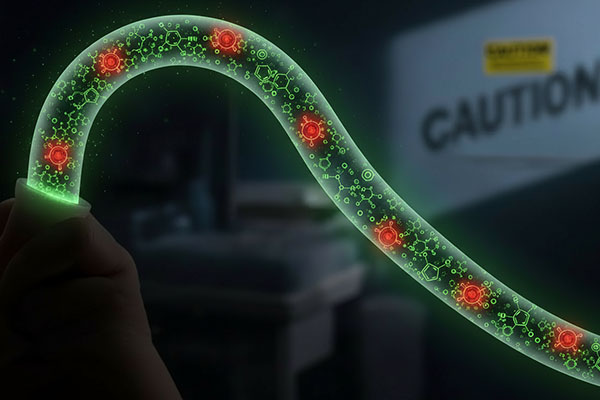
It's not okay when we have 80% of employees worldwide disengaged at work. It's not okay when we have babies born in United States now with 287 chemicals in their cord blood, day one, over half of which cause direct link to cancer and then we have, of course, many linked to mental health issues, learning disabilities, etc. It's a sign of failed leadership and I point that out in my book and I also point out how we can break it up.
The Danger Of Self-Preservation In Global Leadership
It's interesting. Everything you've mentioned provokes a lot of thoughts in me about how do we get here, what brought us to this moment. What I mean by that is it's almost surprising that we got here, that we're still here. I also think that part of this might have been because of the fact that we've had this self-preservation of self-protectionism mentality.
Now, instead of going within and say, "It's about me, me, me," it's about us. Now we have to go outward. That's where when you talk about the masculine versus the feminine, the feminine mentality is more about care, protection caring for others and outwardly focusing and connecting as you say. I think that's what the message for me is. I want to make sure that we're thinking about this as it's not about self, it's about other, but not at the expense of self.
It needs to be a balance there too. Absolutely. That was beautiful, Tony. I like that. It is truly about having a balance between me and us. With us, I mean the problems we're facing now are global. We need a person who can think globally and establish the connections and the relationships needed to create the global solutions that we need whether it's on the climate crisis, the unregulated AI, or unregulated biotechnology. We need that global vision. Like Einstein said, "We can't solve our problems with the same thinking that created them."
The problems we're facing now are global. Therefore, we need a person who can think globally and establish the necessary connections and relationships to create global solutions.
Why are we? Here we are, we're still in that same thinking mindset of how leadership looks like. I think we need to rethink how leadership looks like because I'm just not seeing it what we need right now. I'm not just talking about the United States, by the way. I'm talking about across the globe. How did we get here? I think it's exactly the reason we got to why are we, as a population, and not just in the United States, even though the United States is probably leading the charge, but why are we obese?
It's because of an old mindset that we never knew where our next calories were going to come from and we have this overindulgence into fat and sugar because back in the days, that assured our survival. Possibly back in our days, our survival also depended on these types of leaders that we talked about in beginning of your show that were more aggressive and were able to stand up and very courageously protect their tribe against other tribes.
The problem now is there are no other tribes. We're all in this together and we're going to go down together. I think, unfortunately, we have an unconscious bias just like we have to calories, which we know they're not good for us and yet we eat them we also have an unconscious bias and maybe conscious for some, in who we find qualified and capable to lead. That is a very dangerous bias.

It's not necessarily the one that is qualified and capable to lead. I want to make that very clear because it puts us down in a road of not leading us to well-being. Just like the road down of eating more fat and sugar that we really don't need but we crave is not putting it into more well-being or survival. Quite the opposite. That's what I see in leadership right now, again, I’m stressing all around the world.
Who Is Missing? The Empty Chair Concept
It comes back to this idea, I just love what you've articulated that, that it's about self-preservation. You might elect leaders who will make you personally more comfortable and protect you, but is it going to make the overall society, others more comfortable or better because of the way that person is going to advocate for the overall picture of where the society's going?
I think that's the biggest challenge. We often think self, self, self. Most people do. The concept I love sharing is this idea of the empty chair. The empty chair in the meeting is the stakeholder who's not represented in the room. We need to start thinking, “What is this going to do for the environment, for the future of society, next generations,” things like that? Having that empty chair concept is a right way for us to think, “I might be making this decision based on what I need, but who else do I need to be making this decision for?
Tony, here's something interesting. I'm thinking right now when you mention that, that empty chair to me right now represent the indigenous population. Even more so than women, to be honest, because they make up 5% of the world population, but they sit on 80% of our biodiversity, the biodiversity we still have left and our life depends on. If we can't get that indigenous person and people into that chair, which of course right now we don't have anywhere, really, in the world. I know in New Zealand, they're making an effort to bring them into the conversation.
I'm not sure how it's going in other countries, but I know it's not going very well here. We really need to listen and make sure they are heard because we need their wisdom if we're going to have a bright future. I love that. At the same time, you have the leaders that are at that table and now I'm talking about corporate business here, particularly in United States.
We have everything we need, all within us and around us. There's nothing out there that we have to invent or wait to happen, which is fantastic news.
We know that what they're doing, you want to talk about the me versus us, they're building bunkers to save themselves and their families in countries as New Zealand and others. There is a little bit of that going on as well, which makes you wonder what leader are you if you're building a bunker for survival for yourself and your own family. What exactly is going on and how well are you leading and what is your business all about? Is it about us or is it about me?
We've shared a lot of challenging statistics and elements. What's something positive and hopeful that you want to leave people with as we come to a close soon?
As I point out in The Leadership We Need, actually, we have the great news, the amazing news, and that is we have everything we need all within us and around us. There is nothing out there that we have to invent or wait to happen, which is fantastic news. We just need to wake up and really spend some time developing ourselves, our inner strength, connect with the feminine, bring people into leadership that needs to be in leadership and be that empty chair, as you beautifully said.
With that, things will be extremely bright. I have no doubt. My book is called The Leadership We Need: A New Mindset for a Bright Future. I truly believe in a bright future, I really do. We just need to get to that mindset and get the people and the right thinking and mindset, if you will, and the future will be bright. I have no doubt.
Essential Books For The New Leader's Mindset
I love that mindset. I'm prescribing to that idea. I think there's an idea that we just need to get more people enlisted in this journey. I'm glad that you wrote a book that really helps people think differently. Thank you for sharing that. You're not off the hook yet because we got one last question to ask you, and that is what are 1 or 2 books, maybe 3 that have had an impact on you and why?
I guess I can't say my own book. To be honest, for any author, we know that the biggest impact is going to be that book that you wrote yourself because is that a journey and you learn a lot by writing. Anyway, putting The Leadership We Need aside, two of my favorite books and you probably already read this one but Thinking, Fast and Slow by Daniel Kahneman is an fascinating book. It goes back to thinking. As we know, Tony, thinking creates emotions, emotions and thinking creates behavior. It’s so critical that we understand where our thinking is coming from and talk a lot about the thinking behind, "Why do I want fat and sugar? Why do I want aggressive leadership?”
Another book that I often have my clients read is The Art of Thinking Clearly by Rolf Dobelli, a Swiss guy. We touched on bias here and how we all have biases. That's okay, but we need to understand when biases are holding us back from well-being or living our best life or other things. I do highly recommend The Art of Thinking Clearly by Rolf Dobelli.
We're kindred spirits. Those are two of my favorite books and wonderful things to leave us with and I appreciate you sharing that.
Thanks so much for having me on your show. This has been a true pleasure and I hope we gave your audience some value and some things to think about.
The time has come where we all need to step up and be leaders—not just in our own lives, but to take it to the next level wherever we can.
I have no doubt about that. It's been wonderful to have you on the show and thank you for bringing all of your stories and everything about what you're doing in the world. It is the time for us to lead in different way and I'm so glad that you're on this mission to create that.
I just wanted to point out, for those of you that think we went pretty big and high as far as leadership, in the end of The Leadership We Need, there are actually assessments that you can take yourself to make bring the leader in you out and get clarity on your strengths, on your core values, and how to create your specific purpose around leadership.
Don't get fooled because I know we spoke pretty high-end here about national leaders and corporate business leaders. In the end, it's all about you and I'm thinking for 2026, what a better place to start when than focus on you and how you can show up maybe a little bit differently in 2026, even stronger and with a new perspective that is going to work for you.
I think there's something about that. I always say everyone's a leader in some way, especially with the world being so interconnected, we all can make an impact from wherever we are with what we've got. I think that's a great message for us to leave people with. We're not leaving people high and dry here. We're leaving them with one other way for them to connect with you. We need to let them know where can they find out more about your work and stay connected with you.
They can find me on LinkedIn under Maria Brinck. They can also find me at my website, MariaBrinck.com. I like what you said there. I think the time has come where we all need to step up and be leaders not just in our own lives but really takes it to the next level wherever we can. I think 2026 is going to be great. I really do. I'm very excited about it.
Thanks to the readers for coming on the journey. I know you're leaving with some energy to go out and make this new year something remarkable and to lead in a different way. You've got two people here who have your back. There you have it. That's a wrap.
Important Links
- Maria Brinck
- The Leadership We Need
- Thinking, Fast and Slow
- The Art of Thinking Clearly
- Maria Brinck on LinkedIn
Love the show? Subscribe, rate, review, and share! https://www.ipurposepartners.com/podcast

0 comments
Leave a comment
Please log in or register to post a comment